If you live in South Jersey, there is a good chance your neighborhood has a history that predates the cul-de-sac, the two-car garage and the development sign at the entrance.
Long before South Jersey became one of the most populated suburban regions outside Philadelphia, much of the area was farmland. Family farms stretched across what are now some of the region’s busiest communities. Roads that now carry thousands of cars once carried farmers, horse-drawn wagons and produce headed to nearby markets. Then, South Jersey changed.
As Philadelphia and Camden grew and more people moved into the suburbs, farmland began giving way to residential development. In some cases, entire farms disappeared beneath new streets and houses. In others, pieces of those farms survived, leaving behind historic homes, mature trees, unusual property lines and, occasionally, a name that gives away what used to be there.
Some South Jersey neighborhoods are, quite literally, built on old farms.
Barclay Farm: From 168 Acres to a Suburban Neighborhood
One of the clearest examples can be found in Cherry Hill.
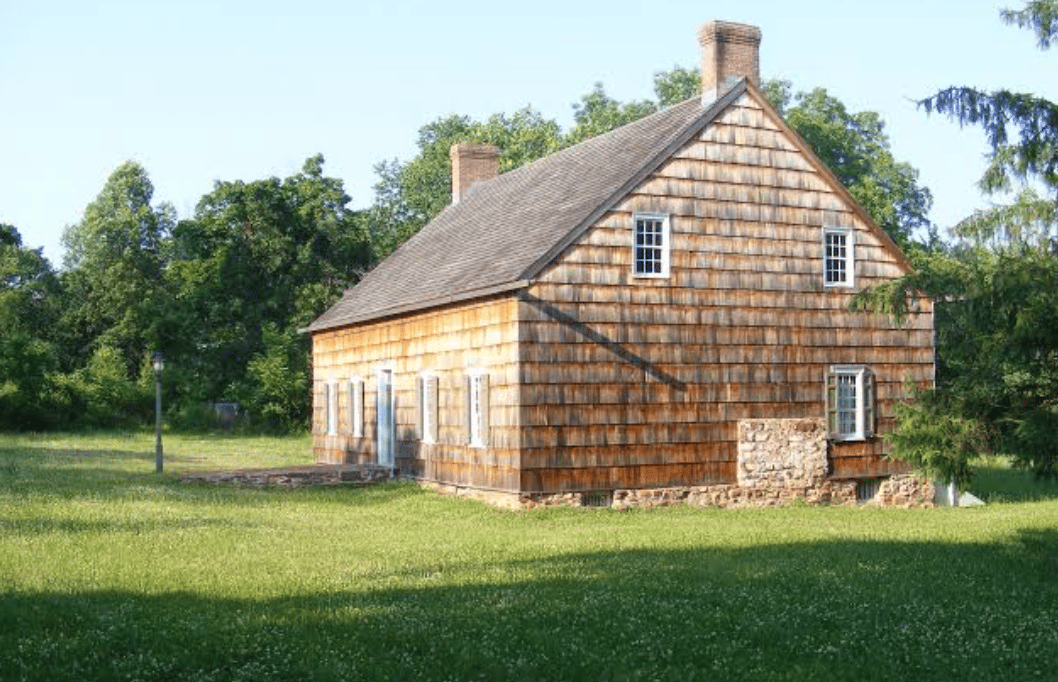
The land now associated with Barclay Farm has been tied to farming for centuries. John Kay, an early settler, acquired the property in the late 17th century. Joseph Thorn later purchased the 168-acre property in 1816 and built the brick farmhouse that still stands today.
The property eventually became known as Chestnut Grove Farm and passed through the Cooper and Barclay families.
Then came the suburban boom.
In the 1950s, Helen Barclay sold a substantial portion of the original farm to builder Bob Scarborough. Scarborough developed the land into the residential community now known as Barclay Farm.
The original farmhouse and 32 acres remained. In 1974, Cherry Hill Township purchased the remaining farmstead, preserving the historic property and the surrounding land.
So when residents drive through Barclay Farm today, they aren't simply driving through a neighborhood with a nostalgic name.
The neighborhood surrounds a piece of the actual farm that came before it.
That is one of the more interesting things about South Jersey real estate: sometimes the history isn't gone. It's sitting right in the middle of the neighborhood.
The Orchards at Greentree: An Actual Orchard Became a Neighborhood
In Marlton, the story is even more obvious if you know where to look.
The Orchards at Greentree was built beginning in 1980 on the former Byron T. Roberts Farm, a roughly 300-acre family-run agricultural property.
The Roberts farm wasn't just open land. It was an apple, peach and pear orchard, Christmas tree farm and fruit-packing operation that had been operating since the 1910s.
Byron T. Roberts was also deeply involved in New Jersey agriculture, serving in leadership roles with organizations including the New Jersey Peach Council and New Jersey Apple Growers.
The farm was sold in the late 1970s, and residential development followed shortly afterward. The Orchards at Greentree began construction in 1980.
Today, residents can live in a neighborhood surrounded by modern South Jersey conveniences while knowing that the land beneath their homes once produced fruit and Christmas trees.
The name “The Orchards” isn't just marketing.
It is a reminder of what was actually there.
Country Farms: When “Country” Was More Than a Selling Point
Another Marlton example is Country Farms.
The neighborhood dates to 1979 and was developed by Paparone Construction on what had previously been open farmland. The original marketing leaned heavily into the idea of a peaceful country setting, offering buyers a quieter environment while still putting them close to major transportation routes.
The original homes were offered in several models with names that fit the setting: Springhouse, Millstone, Harvester, Farmstead and Windhover II.
The Springhouse model started at $55,900, while the larger Windhover II began at $70,900.
Central air conditioning was an optional upgrade.
For $1,500.
That is a pretty good reminder of just how different the South Jersey housing market looked when these neighborhoods were first being built.
Today, Country Farms feels like an established suburban community. In 1979, it represented something much newer: the transformation of South Jersey farmland into the modern suburban neighborhood.
Mount Laurel: When the Farmland Started Disappearing
Marlton wasn't alone.
Mount Laurel remained largely rural and agricultural well into the 20th century. The Mount Laurel Historical Society notes that the township originally contained numerous farms and several small villages.
That began to change dramatically in the 1960s.
According to the Historical Society, Ramblewood began construction in 1962 and became the first of many large housing developments that would transform Mount Laurel.
The change was significant enough that the 1975 New Jersey Supreme Court case Southern Burlington County NAACP v. Mount Laurel described the township's earlier character as primarily rural and agricultural. The court noted that residential development began accelerating after 1950 as the township became part of the growing suburban area around Camden and Philadelphia.
Today, driving through Mount Laurel, it can be easy to forget just how rural the township once was.
But the development patterns tell the story.
Large residential communities, roads, shopping centers and commercial corridors gradually replaced much of the open farmland that had defined the area.
Cherry Hill's Farms Tell Another Story
Cherry Hill may be one of the best examples of how quickly South Jersey changed.
The township's own planning documents describe Cherry Hill's roots as an agricultural crossroads and note that early development occurred across large areas of farmland held by individual families.
In 1954, Cherry Hill had approximately 84 farms.
Then suburban development accelerated.
The opening of the Delaware River Bridge in 1926, the rise of automobile travel and the postwar housing boom all helped change the township. Farmland was gradually parceled out and developed into residential neighborhoods, commercial areas and roads.
But Cherry Hill has also spent decades preserving pieces of that agricultural history.
Barclay Farmstead remains one of the most recognizable examples.
Croft Farm is another. Its history stretches back to the 17th century, and the property was used for agriculture for generations. In the 20th century, the Croft family used the property specifically for farming before Cherry Hill Township purchased it in 1985 for preservation and community use.
And then there is Holly Ravine.
Holly Ravine: A Farm That Almost Became Something Else
Holly Ravine is perhaps the most interesting modern example because its story is still unfolding.
The farm, located near the intersection of Springdale and Evesham Roads, was associated with the Gilmour family and became particularly well known for its Cowtail Bar and petting zoo.
As Cherry Hill developed around it, the farm became an increasingly unusual sight: a working agricultural property surrounded by one of South Jersey's most established suburban communities.
In 2024, Cherry Hill Township purchased approximately 23 acres of Holly Ravine Farm for about $3.8 million after a proposed senior housing development on the property was rejected. The township committed to preserving the property as open space.
And the story took another turn in 2026.
Rather than allowing the land to disappear completely into suburban development, the township moved toward bringing agriculture back to part of the property. In October 2026, Springdale Farm was selected to farm approximately nine acres of Holly Ravine.
In other words, one South Jersey property has experienced nearly the entire cycle:
Farm → development pressure → preservation → farmland again.
That is a remarkable story for a community that is otherwise overwhelmingly suburban.
Look Closely at Your Neighborhood
The next time you're driving through Marlton, Cherry Hill, Mount Laurel or another South Jersey suburb, take a closer look.
That neighborhood with the mature trees may have once been an orchard.
That road with an unusually wide right-of-way may have started as a farm road.
That old farmhouse sitting between newer homes may be the last surviving piece of a much larger property.
And a neighborhood name like The Orchards, Country Farms or Barclay Farm may not be a coincidence.
South Jersey's suburban landscape wasn't built from scratch.
It was layered over the landscape that came before it.
Farms became subdivisions.
Farm roads became major thoroughfares.
Barns disappeared and shopping centers took their place.
Fields became backyards.
But pieces of that agricultural past are still visible if you know where to look.
For homeowners, buyers and anyone who has spent years driving around South Jersey, that's what makes the area's real estate history so interesting.
You aren't just buying a house in South Jersey. In many cases, you're buying a small piece of what came next after the farm.